 The Calm Journal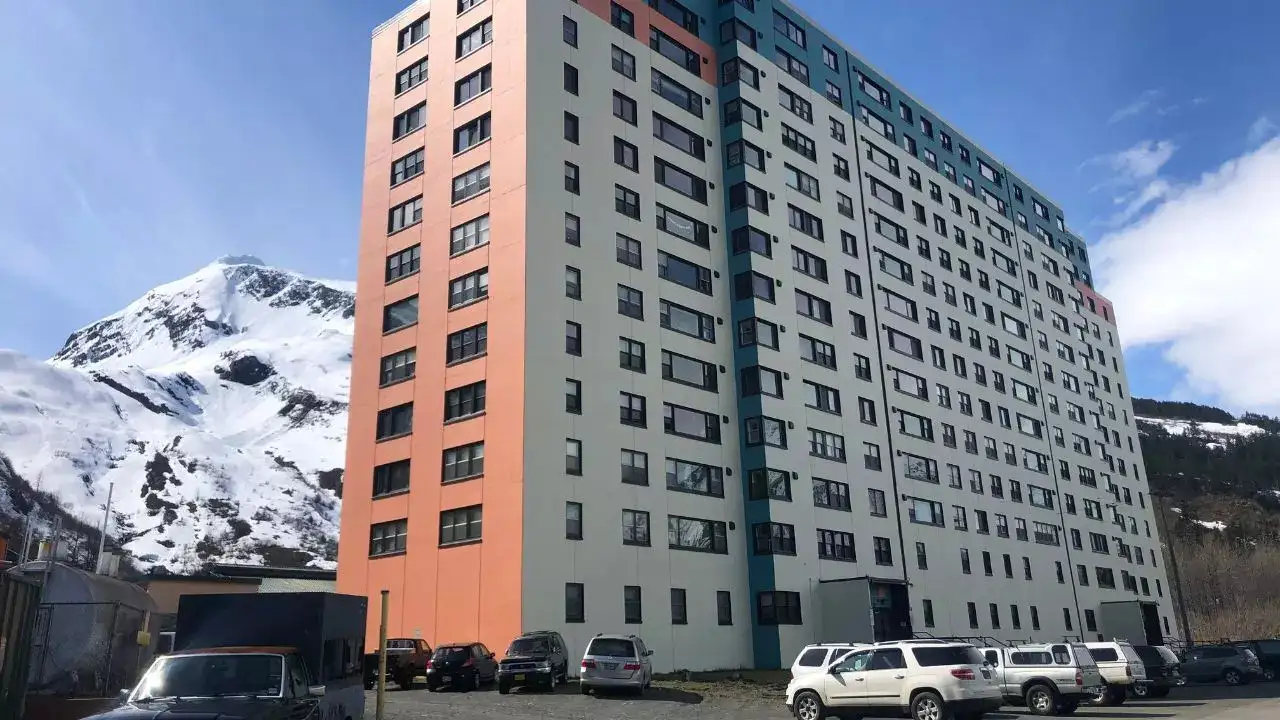
Imagine waking up on a Tuesday. You need to drop your kids off at school, pick up your mail, buy groceries for dinner, and maybe visit the police station.
In any other town, that’s a two-hour trip involving traffic, parking, and freezing cold weather.
In Whittier, Alaska, you can do all of that in your slippers without ever stepping outside.
Welcome to Begich Towers, a 14-story Cold War relic that houses almost the entire population of the town. It is a real-life “arcology”—a massive building that functions as a self-contained city.
Here is the logistical reality of living in the wildest apartment complex on Earth.
Why cram a whole town into one building?
First, let’s clear up the misconception: It’s not a cult, and it’s not a social experiment. It’s a survival tactic.
Whittier is located on the edge of the Prince William Sound. It is stunningly beautiful, but the weather is violent. We’re talking about:
- 60 to 80 mph winds as a standard Tuesday.
- 20 to 25 feet of snow per year.
- Temperatures that make your face hurt.
If everyone lived in separate houses spread out across the bay, the cost of heating those homes and plowing the roads connecting them would be astronomical.
By putting everyone in Begich Towers, the town centralizes its heating and electricity. It’s a massive efficiency hack. The walls are thick concrete (it was built by the Army to withstand bombing), so it keeps the brutal Alaskan weather out and the warmth in.
The “Slipper Commute”: How life works inside
The building isn’t just apartments. It is a fully functioning ecosystem.
- Floors 1-14: Residential apartments (mostly).
- The Basement/Ground Floor: The town center. This includes the Post Office, a General Store, the Police Station, the Laundromat, and a small Church.
- The School: The school is actually a separate building behind the towers. But don’t worry—the kids don’t have to walk through the snow. There is an underground pedestrian tunnel that connects the apartment tower directly to the school.
A child in Whittier can literally go from Pre-K to high school graduation without ever needing a snow jacket to get to class.
The Gatekeeper: The One-Way Tunnel
If living inside a vertical city sounds claustrophobic, leaving is even harder. Whittier is one of the most isolated towns in the US accessible by road.
To get in or out, you have to drive through the Anton Anderson Memorial Tunnel.
- It is 2.5 miles long (the longest highway tunnel in North America).
- It is only one lane wide.
- It is shared by cars AND trains.
The Logistics of Leaving: You can’t just leave whenever you want. The tunnel runs on a strict schedule. Cars drive East for 15 minutes, then the tunnel closes to let the train through, then cars drive West.
If you go to Anchorage for a movie and miss the 10:30 PM tunnel opening, you aren’t getting home. You are sleeping in your car until morning. This timetable dictates the entire rhythm of the town.
5 Curious Questions Everyone Asks
I know what you’re thinking. Here is the reality behind the weirdness.
1. What do people actually do for work?
They aren’t just sitting in their rooms. Whittier is a working town.
- Commercial Fishing: It’s a major deep-water port.
- Tourism: Massive cruise ships dock here during the summer.
- The Railroad & Ferry: State employees run the transport links.
- Maintenance: Keeping a 14-story building running in sub-zero weather takes a dedicated crew.
2. Is there crime inside the building?
Very little. It’s hard to get away with anything when the police station is down the hall and the only road out of town closes at 10:30 PM. Everyone knows everyone. If you play your music too loud, the whole town knows.
3. What about the other giant building?
If you look at photos of Whittier, you’ll see a second, larger, creepier building nearby. That is the Buckner Building. It was once the largest building in Alaska, complete with a bowling alley and theater. It was abandoned after the 1964 earthquake damaged it. Now, it sits empty, flooded, and decaying—a “ghost ship” right next to the lived-in tower. (And no, you can’t go inside; it’s full of asbestos).
4. Do they get “Cabin Fever”?
Yes. Locals call it “The Powell” (named after the street the tower is on). When the weather is bad for weeks and you haven’t seen the sun or left the building, tensions can get high. That’s why many residents have “Whittier cars”—beater cars they park on the other side of the tunnel just to escape easily.
5. Can I visit?
Absolutely. There is a hotel (the Inn at Whittier) and you can rent condos inside Begich Towers on Airbnb. Just remember: bring cash, don’t expect 5-star luxury, and check the tunnel schedule.
The Verdict
Whittier proves that humans can live anywhere if the logistics make sense.
Most of us spend our lives complaining about the commute, the heating bill, and shoveling the driveway. The people of Whittier looked at the harshest environment in North America and said, “Let’s just move in together.”
It’s efficient, it’s cozy, and it’s the only place in America where you can technically go weeks without breathing fresh air—and be perfectly happy about it.